
Happy Holidays to all from the Voss Family!
top of page

NEWS
NEWSLETTER
Search

THE CENTRAL LIBRARY OUTREACH PROJECT: SERVING HOMELESS
Need a replacement Social Security card? We can help! Need a medical appointment? Talk to Curt! Need to get an email sent or use a phone? You are next in line.
Twice weekly, representatives of several nonprofit agencies staff the Outreach Project at the Central Library. The two-hour sessions, operating since early July, touch a dozen or so people, 15 or more on a jam-packed afternoon.
Curt Covington—homeless himself for five-plus years—works the project for Hope Ministries. Rob Zlomke, street outreach worker for Primary Health Care, greets many clients. Willi Jacques-Asor, of the Central Iowa Trauma Recovery Center, connects folks to mental health services. Tim Mohammad is with Standup Wireless, a government benefit program with tablets and phones for low-income households. Staff from Central Iowa Shelters and Services also participate on occasion.
“What we provide,” Rob explains, “is a warm handoff to access other resources—housing, shelters, Medicaid contacts, veterans’ programs. We have a list of all known community resources. But if we don’t have an answer, we tell folks, ‘Come back Friday, and we’ll get you connected.’
“I’m passionate about this work. I just gotta be around people, talking to folks, and helping them get to a better place.”

BUILDING COMMUNITY, ONE NOTE AT A TIME
In 2020, Tim Bohlen figured it was high time for townhome residents in the east-of-downtown Bridge District and the nearby Verve and Velocity apartment dwellers to get to know each other. Tim’s path: live music.
So during the height of COVID, Tim, who moved to the district with his wife, Diane, in 2017, organized a dozen Sunday afternoon concerts at the Bridge common area. He repeated the efforts in 2021, organizing two-hour Music on the Bridge concerts. Performers this year included The String Prophets, Jason Walsmith, the Ducharme-Jones Band, and Chad Elliott.
“Musicians loved it, and it’s a cool place to play,” reports Tim who, with Diane, numbered among the district’s first residents.
Tim did all of that with zero impresario experience. He and Diane love live music, but he didn’t have one musician’s email or cell phone. He had no idea what to pay a singer-songwriter.
But he figured if he promoted concerts to the homeowners association and Indigo Living property managers, people would show up with lawn chairs, blankets, and coolers.
And show up they did—concerts drew 30 or 60 residents and guests. Passing the hat more than covered Tim’s guarantee to musicians. Neighbor Brad Dondlinger provided a 100-feet extension cord to power band speakers that run from Bill Schoenberger’s front yard outlet to the concert area.
“I’m a neighbor guy,” Tim confesses. “And a little bit of a pot-stirrer. There’s power in this—how we work and live together, shoulder to shoulder with neighbors.”
The 2022 season is scheduled to open on May 15 with a concert by Opus Taylor. Local nonprofit Starts Right Here, organized by Will Keeps, will underwrite it.
Springboarding off the Bridge District model, Hubbell Realty senior communication specialist Claire Brehner reports organizing four monthly concerts this summer at Gray’s Station.
Concerts to build your neighborhood? Yes, you could do it—a nearby park, someone’s front yard, a church parking lot, a blocked-off street. It just takes one pot-stirrer. Like Tim Bohlen Tim.bohlen76@gmail.com.
IMPROVED RESPONSE TO MENTAL HEALTH 911 CALLS
At our December 6 council meeting, Des Moines and Broadlawns Medical Center entered an agreement to place a trained mental-health clinician in the Des Moines Police Department 911 dispatch department. This is a seismic shift in mental-health response. In the first phase, a clinician will be on duty 40 hours a week and work closely with dispatchers, each of who have received 16 hours of training on mental health response.
From details to the Council and public: “To embrace an emerging industry best practice, the Police Department and Broadlawns developed a natural extension of Mobile Crisis Mental Health Response Team (MCRT) which will divert appropriate 911 calls that are not criminal in nature or medical emergencies to well-trained mental health clinicians.
“Per the diversion response model, a member of the Crisis Advocacy Response Effort (CARE) will assist the caller in crisis by phone or in person, but generally will not be accompanied by a police officer or EMS professionals.”

BIOSWALES: NOT YOUR TYPICAL STREET PROJECT Take a gander at new Market District streets under construction, and you are apt to say to yourself, “What the heck is this about?”
In the photo above, Ryan Companies workers form bioswales along Elm Street that will be transformed into vegetated retaining ditches to collect, filter, and convey stormwater from streets, parking lots, and rooftops.
Bioswales are open rain gardens along streets that use plants to absorb stormwater and pollutants that would otherwise flow through underground stormwater pipes. The bioswales capture about 25 percent more runoff than most projects and reduce pollutants that could reach streams and rivers. Additionally, the rain gardens help reduce heat island impact and provide some habitat for birds and insects, creating a healthier environment for the district.
The cross-section illustration below provides an example of what contractors are engineering beneath Elm Street. The bioswales network is about 6 feet below grade; the top layer of soil varies from 22 to 30 inches.
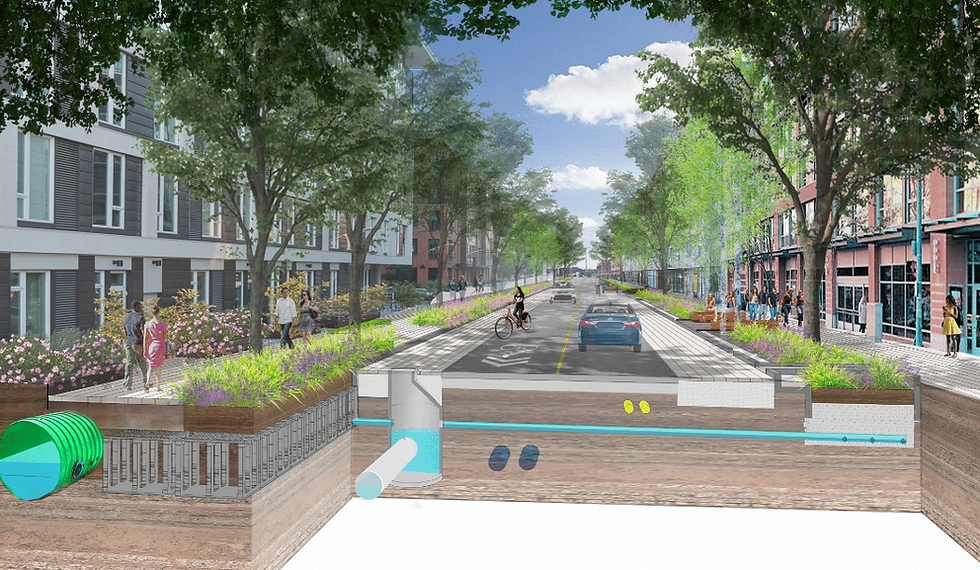
Denver-based Design Workshop, the Market District consultant, has completed similar projects in Houston, St. Louis, Salt Lake City, and Wheaton, Illinois (suburban Chicago). The Market District bioswales are among the first in Iowa to accommodate future building roof water.
Houston’s Bagby Street project has been recognized as Texas’s first certified green-road project. The rain gardens remove up to 93 percent of the oil and grease from the roadway and improve downstream water quality.
COMING IN 2023: PRINCIPAL PARK UPGRADES
You may have learned that in 2020, Major League Baseball (MLB) stepped up to the plate to take a more prominent role in minor league baseball—from the number of farm clubs to schedules to facility improvements. You also may have heard that earlier in December, the private equity fund Diamond Baseball Holdings purchased the Iowa Cubs along with eight other minor-league baseball clubs.
This reorienting of minor-league baseball has spurred the necessity of updates to the Cubs’ downtown home, Principal Park, the oldest park among the 30 Triple-A affiliates. Because Principal Park is part of the city’s parks and recreation system, the City Council will vote next year to approve Phase 1 updates before the 2023 season. The updates, which are expected to cost $6.5 million, are necessary for Des Moines to retain a Triple-A club under MLB’s decrees.
Fans won’t notice most changes, including larger visitor locker rooms, upgrades for female coaches and female umpires, and a more significant weight room. But Phase 1 plans also include upgrading the solid green center field wall known as the “batter’s eye,” which helps hitters track pitchers’ fastballs smoking in at 90-plus mph. The new 30-foot-high wall will minimally block the view of the Iowa State Capitol from the lower rows of seats behind home plate.
Historically, triple-A baseball has been one of Des Moines’ favorite spring and summer pastimes. Although Des Moines is one of the smallest Triple-A cities and one of the smallest metro areas, the franchise has consistently been one of minor-league baseball’s best drawing cards. In pre-COVID years, the I-Cubs finished in the top 15 for fan attendance among 160 minor league teams (now down to 120).
The I-Cubs have been a major-league economic engine as well. In 2016, the most recent survey, the ballclub was credited with $15.65 million in regional output, including 200-plus jobs worth $5.3 million in income. Total industrial output to the Des Moines metro area was outlined at $29.53 million.
With baseball on our minds, here are the walk-up tunes for current players in the decision-making. According to Sports-Net.org, “Walk-up songs are something to be taken very seriously. The 10 seconds of ear magic represents who you are and should leave a memorable impression on the stadium.”
Mayor Frank Cownie
Council Member Bill Gray
“Centerfield” by John Fogarty
Council Member Linda Westergaard
“Forever Young” by Bob Dylan
Council Member Josh Mandelbaum
“I Feel Good” by James Brown
Council Member Joe Gatto
“Thunderstruck” by AC/DC
Council Member Connie Boesen
“Authority Song” by John Cougar Mellencamp
Council Member Carl Voss
“Madness on Main Street” by The Blue Band
Des Moines Park and Recreation Director Ben Page
“The Cheap Seats” by Alabama
Iowa Cubs president/GM Sam Bernabe
“Don’t Stop Believing” by Journey

SIXTH AVENUE BUS SHELTERS: OUT OF THE ORDINARY
The first of 12 new DART bus shelters were installed earlier this month in the Sixth Avenue Corridor just south of Jefferson Avenue. The Des Moines Public Art Foundation commissioned contemporary artist Sheena Rose to design the first seven shelters.
The 6th Avenue Corridor Main Street Program led the fundraising and financial contributions for the art component of the project, part of a $1.5 million streetscape project. Funders include Polk County, Prairie Meadows, Wells Fargo, MercyOne, the Community Foundation of Greater Des Moines, Bankers Trust, the Wellmark Foundation, and the Iowa Great Places Program.
---------------------------------------
BRIEFLY
• Expect a December 20 Council agenda item to approve an RFP for a Climate Action Plan. The plan development is expected to take 18 months.
• Look for the first round of parking pay stations to go live in late January, in the west end of downtown. The project, replacing 3,500 parking meters will 400 pay stations, should be completed by April or May. The project cost: $3 million.
More details ⬅️
• Earlier this year, MidAmerican Energy reported that wind turbines supplied more than 80% of its generated electricity, as opposed to 29% worldwide. Ride along with Scottish pro cyclist Danny MacAskill as he explores wind power on his trick bike.
• In November, Heather Tamminga joined Neighborhood Services as the City’s neighborhood outreach coordinator. Heather is a new (additional) City resource to assist our 50-plus neighborhood associations.
Here’s a sure sign of colder days ahead: The first majestic American bald eagles have returned to their winter feeding below the Scott Avenue dam. I saw three on my Thursday morning run. Bee-U-tiful! Bring your binoculars and head to the Scott Avenue or East Sixth bridge to take in the views. By chilly January, there should be 25 or more eagles to enjoy.
Be sure to check out the festive winter lighting of Dogtown just east of Drake University. The University Avenue lighting project between 23rd and 24th streets—funded through a $75,000 Wells Fargo grant—is scheduled to premiere at 5 pm on Saturday, Dec. 18. The LED lighting scheme, created locally by Mike Lambert as part of Invest DSM, is scheduled to remain in operation through the winter months.
TUESDAY: DON’T FORGET TO VOTE!
November 2 is Election Day for Iowa’s municipalities and school districts. If you haven’t already cast a ballot (mailed an absentee ballot or voted early at Polk County Election Office), Tuesday is the day for your civic duty.

DE-ESCALATION TRAINING IN THE BOOKS. HOW DID IT GO?
More than 400 Des Moines Police Department members—including all administration staff, detectives, beat cops, and dispatchers—recently completed 16 hours of de-escalation training at a facility near Camp Dodge. Police Executive Research Forum (PERF) trainers led eight classes through the Integrating Communications, Assessment and Tactics (ICAT) program. The City invested $148,436 in the training.
“We learned some different strategies and tactical approaches for things we were already doing,” says Alberto Marquez, a four-year veteran of the force, who described the two days of ICAP classes in August as the best training he’s attended as a DMPD officer.
One of his big pluses was sitting in the same room with dispatchers, detectives, and the administrative staff. Open conversation flowed. “This put everyone on a level playing field,” says communications administrator Brad Button. “This training will impact the team aspect throughout our building.”
PERF executive director Chuck Wexler agreed. “If the dispatcher asks the right questions and gets the right info to the cop, the information becomes so invaluable on how the officer responds.”
After a day of classroom work, the Washington, D.C.-based PERF team set up scenarios with retired officers, active officers, and actors. All DMPD officers worked through three scenarios:
· Despondent individual with a knife in a confined outside space; only threat to himself.
· College student in a classroom who had just received his first failing grade. He had a baseball bat and was a threat to his professor and classmates.
· An individual was fired from his job and armed with a knife. He intended to damage his boss’ car. Wide-open space.
“For first responders, emotions are high and rational thinking is low,” says Don Alioto, PERF senior principal, who led the Des Moines classes. “The officer’s job is to get the two—emotions and thinking—closer in alignment, then listen to what individuals are saying. And get a good outcome.
“So often, when police are dealing with someone in crisis, they are only a threat to harming themselves or making others uncomfortable. It doesn’t involve a criminal act. Our training is to listen to understand—not respond. Don’t get caught up in the culture of speed. Take a tactical pause. Wait until you’re in a really good spot.”
Don says he was impressed with everyone’s attentiveness: “These were some of the most pleasurable classes that I’ve led. There was a lot of note-taking and great conversation after classes.”
Alberto and his partner, Angel Perez, credits the new tactical approach with preserving the safety of innocent bystanders not long after they attended the class.
A DMPD dispatcher summoned the duo to a second-story apartment, in which an individual was suffering from a meth withdrawal. Also present were the 911 caller—a female friend of the individual— and the individual’s girlfriend. “There were narcotics and mental health issues to resolve,” Alberto describes. “The adult male appeared to be bipolar, going from extremely violent to compliant.”
The dispatcher arranged for the civilian mobile crisis team to park nearby. “We had all the resources we could have,” Alberto remembers. “We didn’t rush in. We took a little bit of time to get a feel of what was going down.”
What they saw was the individual had his girlfriend in a bear hug. The officers talked the individual through it. The two women left safely. “My partner and I didn’t do anything to bring up the stress level—we just glided through the situation,” Alberto recalls. “We remained calm.
“And at the end of my shift, I was content with the outcome. We had preserved the safety of innocent bystanders.”
MORE GUNS TAKEN OFF THE STREET
By year’s end, the Des Moines Police should set a department record for the number of guns taken off the street. As of a couple of weeks ago, 345 had been removed. In 2020, 381 guns were eliminated, more than one gun a day. Guns have been seized during commission of crimes, from felons illegally possessing them, and from underage youth.
Beginning July 1, a new Iowa law legalized carrying a handgun in most public places—permits optional.
DOGTOWN LIGHTING IN THE WORKS
As part of Invest DSM initiatives, Wells Fargo has agreed to underwrite a $75,000 lighting display for the Drake Neighborhood’s Dogtown Business District. Eleanor Kahn, a Chicago-based artist and Drake Neighborhood artist-in-resident, has teamed with Mike Lambert, a local lighting designer, to celebrate winter—in Dogtown fashion—along University Avenue between 23rd and 24th streets. Look for details as mid-December approaches.
BROADWAY RETURNS TO THE CIVIC CENTER
The national touring company of The Band’s Visit—winner of 10 Tony Awards, including Best Musical—wrapped up eight performances in October. It marked the first Willis Broadway Series performance in Des Moines since February 2020.
Attendees had to present a vaccination card or evidence of a recent negative COVID test, and pick up playbills from a table. The Civic Center also completed HVAC upgrades to improve air exchanges.
“We were pleased to welcome folks back to a place they hadn’t been in 19 months,” communications director Jonathan Brendemuehl reports. “We had good crowds for all eight performances. The road to the return of Broadway has been a positive experience.”
Touring companies report about 25% no-shows nationally. Des Moines attendance mirrored those numbers.
Tootsie, the next musical in the Willis Broadway Series, opens February 8.
KIND WORDS ABOUT THE SAVING THE VARSITY THEATRE
In an article about independent theaters, Washington Post film critic Ann Hornaday recently wrote glowing words about the Varsity Theatre. Des Moines Film, a local nonprofit, is driving a $3 million campaign to reopen the shuttered movie house in Drake’s Dogtown. Click on this link to donate.


PARK VISITORS LOVE THEIR PLAQUES
Jacob Naumann, yellow vest, and Ryan Clutter, olive jacket, install the first batch of commemorative plaques Tuesday afternoon on the Chris and Marcie Coleman Bridge in Gray’s Lake Park. These Parks and Recreation volunteers had 20-plus first-time plaques to install on the recently dedicated bridge. Jacob and Ryan will install another 40 plaques on the Riverview Park Bridge and add a handful of new plaques to the Fifth Street/Jackson Street/Green Bridge.
Commemorative plaques are now available for $200 each on a bridge. A similar plaque program for the Gray’s Lake Park Bridge railings is sold out. Proceeds support local causes.
Interested in a commemorative plaque? Details: https://www.dsm.city/departments/parks_and_recreation-division/programs/bridge_plaques.php
NUGGETS FROM 2020 COMPLETE STREETS REPORT
At Wednesday’s all-day work session, City Council members and the public got the first look at the 2020 Complete Streets Report, the second annual. Here are some highlights:
· Driving in 2020 during the pandemic was more dangerous, as motorists’ behavior and psychology shifted:
- Vehicle miles driven (VMT) dropped 40% initially, then leveled off at 15% below average.
- Despite fewer VMT, fatalities increased, jumping from 15 to 23, including three multiple-fatality crashes, resulting in eight deaths.
- “Lost control” entered the top 10 major causes for crashes at No. 4, indicating people were driving faster and more recklessly.
- In addition, the Iowa Department of Transportation (DOT) reported a record number of speeding tickets issued for traveling in excess of 100 mph.
· Vulnerable users, including pedestrians, cyclists, and motorcyclists, were disproportionately killed or seriously injured in crashes. It was a particularly rough year for motorcyclists, whose deaths rose 26%.
· Des Moines is steadily closing sidewalk gaps, adding bike facilities, and installing Americans With Disability Act-compliant ramps at intersections. But, we’re not accelerating to the finish line.
· In 2020, new concrete closed 7.06 miles of Priority 1 sidewalk gaps, including City and private projects.
And finally:
Neighborhood traffic-calming requests are through the roof. “Drivers are going too fast” is the No. 1 complaint Council members hear from residents.
FIRST LOOK: FOOD SECURITY TASK FORCE REPORT
Also, at Wednesday’s work session, members of the Food Security Task Force shared their report, packed with information to assist residents with urban agriculture and sustainability info, and recommendations for best practices. Two of them:
1. Create a specific Des Moines Municipal Code Chapter to address urban farming. For example, the line between hoophouses (generally, temporary structures) and greenhouses (permanent structures) isn’t well defined.
2. Reconvene the Task Force for another six months, focused on commercial urban farming, food access, food waste, and protecting the other ancillary systems, as well as resources that ensure food security.
Here’s information from FEED DSM.
4-WAY STOP SIGN COMING TO EAST 5TH AND GRAND
At its October 18 meeting, the City Council voted 7-0 to make East Fifth and Grand a four-way stop. The intersection, the site of four businesses, was the only corner between East 12th and 18th streets near the Central Campus lacking a four-way traffic control. The Historic East Village Neighborhood Association petitioned the Council to add the stop sign for the safety of pedestrians.


HISTORIC HOTEL FORT DES MOINES REOPENS
The gran damme of Des Moines hospitality—the Hotel Fort Des Moines at Tenth and Walnut Streets—is now welcoming guests. The hotel hosted 12 U.S. presidents, Nikita Khrushchev, Mae West, and Charles Lindbergh, in its storied history. And who could forget Tiny Tim, who took up residency here in the 1990s?
The reopening of the 1919 hotel, listed on the National Register of Historic Places, was delayed a year due to COVID. The two-story lobby—covered for 60 years during a remuddling—has reappeared in its original glory. Yes, worth a trip downtown to check it out.
Hawkeye Hotels closed the building in 2015; it has reopened as part of Hilton Hotel’s Curio Collection.
The price tag on the remodel and update: $50 million.

3 MILES OF NEW TRACK; SPIKES DRIVEN BY HAND
At the Des Moines Industrial building site, crews are laying nearly three new miles of railroad track for the transloading facility. And guess what? They’re driving those railroad spikes the old-fashioned 1800s way—one whack of the sledgehammer at a time.
Gabe Claypool, COO of Des Moines Industrial, reports it takes a crew member 6 to 10 swings of the hammer to drive home each spike. This week, crews started pouring tons of ballast between the new rails and tracks.
The 31-acre transportation hub along East ML King will provide warehousing and access to Iowa Interstate, Norfolk Southern, and BNSF railroads. The facility is on schedule to be open in early 2022.
bottom of page