

Let's Catch Up! March '26

QUIETLY LEARNING ENGLISH SKILLS
“My granddaughter wants balloons for her birthday party,” Sue Huber tells her English Language Learning (ELL) students. “Now, write that sentence.”
The former Peace Corps volunteer is one of 12 devoted teachers who dedicate their Tuesday and Thursday evenings to teaching English at Trinity Las Americas United Methodist Church. When I visited, 19 eager students were taking part in this learning opportunity.
The nonprofit 8th & College Connections (8CC) operates the year-round ELL program on a shoestring budget. Having started in 2001, it is free for all participants.
In February, an average of 45 students attended evening classes.
Keeping the lights on is a challenge. Through prayer, miracles, and solid grant writing, the 8CC board scrapes up funds for the $6,000 annual rent, books for students, and child care staff. They receive no federal or state dollars, allowing them to accept all students—no questions asked.
The instructors are all volunteers. “This is a real labor of love for most of us,” program director Jean Vesely told me. For example, Sue has been teaching at 8CC for six years.
Free child care is one of this program’s drawing cards, Jean said, noting, “I don’t know of another program in the area that provides free child care.”
Jean walked me around the building to peek in on the first-floor nursery, where two paid staff cared for five infants and toddlers; and the basement child care room, where two paid staff tended to six youngsters. The child care staff met while taking ELL classes in 2019, graduated from the 8CC program, and then accepted child care jobs.
Upstairs, Tom Maurer’s six Level 3 students worked on a student-suggested geography lesson. "Name all 50 states,” challenged Tom, a six-year volunteer teacher. “Let’s take turns." With one minor redirection—Miami is a city in Florida—they succeeded.
During a break, I spoke with Carlos, one of Tom’s students, who has lived in the Des Moines area for two years and works as a welder, a trade he enjoys.
“At work,” Carlos told me, “everyone speaks English, so I have to learn. I tell my co-workers, ‘Please help me improve my speaking.’ The hardest thing for me is slang. Like 'Throw in the towel.’≈”
Don’t look anytime soon for Carlos to throw in the towel. He’s here for the long haul.

EASTER LAKE SURPASSES 1 MILLION VISITORS
At a recent River Woods Neighborhood Association meeting, Easter Lake Park ranger Jeremy Basset noted that in 2025, the popular Southeast Side green space drew more than 1 million visitors.
Yes, confirms Polk County Conservation Board community outreach supervisor Jessica Lown—1,083,966 visitors, to be precise. “We’re incredibly proud of the community hub this park has become,” Jessica told me.
Polk County Conservation Board director Rich Leopold said he believes Easter Lake to be the most visited county park in the state.
“Jester Park and Easter Lake have switched back and forth in numbers over the last few years,” Rich told me. Jester Park includes a nature center, campgrounds, day-use areas, a golf course, a lodge, and an equestrian center. But in 2025, Rich said, “Easter Lake was just barely over Jester Park in attendance.”
Primarily driving Easter Lake's popularity is the Athene North Shore, dedicated in 2024. The park includes a four-mile paved trail and a covered bridge, shown above. The National Recreation and Parks Association awarded its 2025 Innovation in Equity Award to Easter Lake Park.

CELEBRATING YEAR OF THE RED HORSE
Dat Nguyen was part of a group of women performing a traditional dance on February 28 during the Vietnamese American Community in Iowa's Lunar New Year celebration at the United Steelworkers Local 310 Union Hall, on Northeast Broadway Avenue. Asian communities are celebrating the Year of the Red Horse (or Fire Horse), last celebrated in 1966.
The Thai Dam community will celebrate the Lunar New Year on Saturday, March 14, at the union hall.

FIRST UNION PARK MAKEOVER SOLD
A two-story home at East 13th Street and Guthrie Avenue is the first Invest DSM rehab completed in the Union Park Special Investment District since the 2025 expansion into the East Side neighborhood. The three-bedroom, two-and-a-half-bath home sold for its asking price of $320,000 within three days of listing.
“This house was qualified as a public nuisance,” Invest DSM Neighborhood Development Manager Christopher Civitate told me. “It was a good candidate to demolish and rebuild.”
Christopher told me the City partnered with Sequel Architecture & Design, Alt Interior Design, and Cutler Construction for the rehab work. Most of the foundation was replaced.
A second complete rehab overlooking Union Park should be on the market before the neighborhood hosts its fifth annual PorchFest DSM, in early September.

ARTISTS SELECTED FOR FESTIVAL
This year’s lineup for the 2026 Des Moines Arts Festival features 112 artists who have never exhibited at the event, scheduled June 26–28 in the Western Gateway Park. The number represents 57 percent of the 195 invited artists.
Earlier this year, 943 artists from 45 states applied to be selected for one of the highly sought booths. It’s a rigorous selection process by a five-person jury: six rounds of voting.
Persistence pays for artists such as ceramist Jack Charney of Hannibal, Missouri, who applied for 15 consecutive years before getting the nod this year. Printmaker Mel Fleck of Louisville, Kentucky, last exhibited in 2006; he’ll be back this summer after a 20-year hiatus. Also, Joseph Bradley, a Greenville, South Carolina, painter, will be back after an 11-year absence. A Bradley painting of black-capped chickadees, above, hangs in our bedroom.
IMPROVEMENT FULFILLED
It’s so cool for all of us—residents, City Council members, City staff—when some small issue is resolved. Take, for example, the River Woods Neighborhood Association meeting on a recent Tuesday.
It wasn’t the greatest attendance; just five residents, including president Denise Benda and her spouse, Randy; DMPD SPO Scott Baker, Parks and Recreation supervisor Molly Rupert, Easter Lake Park ranger Jeremy Basset, and me. We chatted briefly about myDSMmobile, a terrific app that allows anyone to create a report and log issues, including potholes, graffiti, and tall grass.
I made some remarks about how most City issues are complaint-driven—“See something, say something!”—or words along that line. That’s how potholes are filled, for example.
Randy—bless his heart—brought up an issue of poor visibility of overhead traffic signals for westbound motorists at East University and Hubbell avenues, far from his River Woods neighborhood. I promised to log the complaint and find out what’s up.
Oh, my gosh! Randy was correct. I sent off an email to City Traffic Engineer John Davis the following day. Two days later, John got back to me with the details.
“We conducted a field review of this location,” John emailed, “and observed that the westbound traffic signal displays were not properly aligned, which reduced their visibility. Our field crews will realign the signal heads to improve visibility.”
John added that the improvements will be made in the next couple of weeks.
That’s how it’s supposed to work!
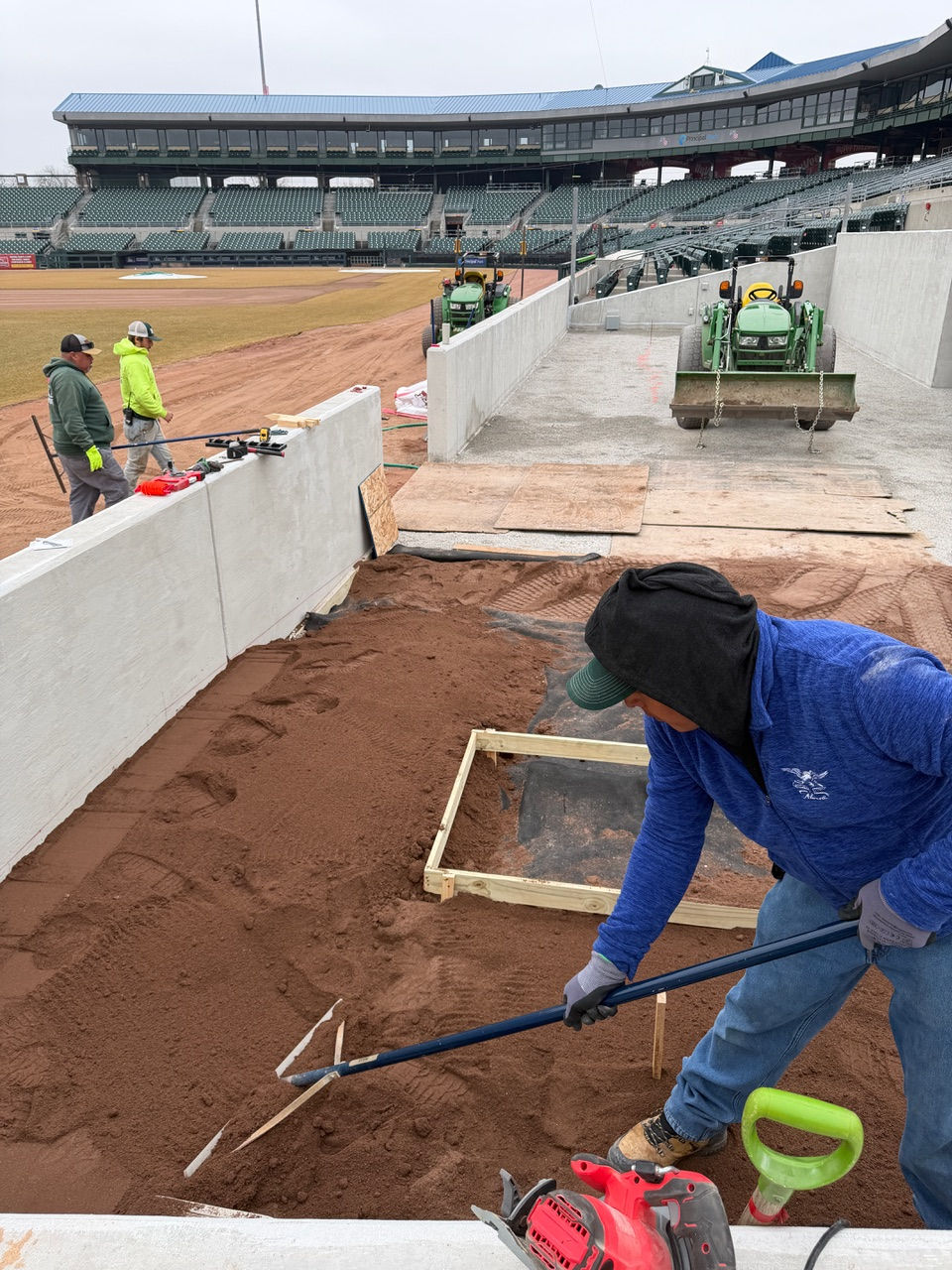
NEW BULLPENS NEARLY FINISHED
A Bush Sports Turf employee from the Quad Cities tamps the infield mix of sand, clay, and silt in the new home bullpen, one of the final steps to prepare for the Iowa Cubs’ 2026 season at Principal Park. The $790,000 bullpens—a safety measure decreed by Major League Baseball—replace on-field warm-up areas for pitchers and catchers. The I-Cubs meet the Columbus Clippers for the home opener, Friday, March 27. Good seats are still available!!

PERSISTENCE PAYS
Tom Duax, owner of Central City Liquors, is one of my “sticky” friends: Tom sticks with an issue until it's resolved.
Tom’s stickiness contributed to the City’s Development Services Department's recent shift to allow the use of river rock for landscaping around trees, shrubs, and plantings at his family’s parking lot west of their store, at Second Avenue and Clark Street. The Duax family upgraded the parking lot with 26 stalls last summer in response to improvements along the Second Avenue corridor.
With river rock surrounding the liquor store’s landscaping, Pat Duax, Tom’s son, assumed river rock would be acceptable around the parking lot improvements, and moved forward with it. Whoa, Nellie! City regulations had changed since the store opened in 2002.
“City code has required wood mulch to be used as groundcover in landscape planter beds,” Development Services director Cody Christensen told me. “The goal of this requirement was to promote plant health and sustain attractive landscaping.
“But after receiving numerous requests to allow rock groundcover in planter beds, as is allowed in most suburban cities, we made a Citywide adjustment to increase the flexibility of allowed groundcover materials that will promote healthy plants in landscaping beds.”
Rock is now allowed in the planter bed, Cody told me, but trees must have a wood mulch ring to promote their health and longevity.
Thanks, Tom, for being sticky. You put the spotlight on this code change. Your persistence prevailed.
Cody reports more amendments to the City’s Municipal Code Chapter 135 to streamline property development or rehab:
Overhead utility lines. In February 2025, the code for buried utility lines was amended to make corridors more attractive by reducing visual clutter, such as overhead utilities, that line many of our streets. The City Council decided to allow more overhead utility lines to remain where physical constraints make them infeasible to bury, or where the cost of burying lines exceeds 10 percent of the total project cost.
“This code change is likely to result in more sites being developed along corridors with overhead utility lines,” Cody said, “but more of those overhead lines will continue to be visible to those who traverse our corridors.”
Cody acknowledged that the cost of such requirements may deter some sites from being developed, but administering City requirements constantly requires weighing multiple factors. In this case, the primary consideration was balancing the cost of visual improvements against developing more sites.
Triggers for redeveloping sites. In May, Cody said, City code was amended to relax site compliance triggers that require site improvements when existing structures are reoccupied after being vacant, when they change from one use to another, or when certain levels of improvements are made. “The primary goal of these changes,” Cody explained, “is to reduce barriers to the reuse and improvement of existing structures.”
This change, Cody said, eliminated the six-month vacancy trigger, reduced the change-of-use trigger such as converting office space to a restaurant, and relaxed the improvements trigger such as updating a building façade.
The changes make it less costly to reoccupy existing buildings, change their use or improve them. But as those improvements are made, they are likely to proceed with fewer site improvements.
Site compliance triggers. In November, Cody said, the City code was amended to further relax site compliance triggers, clarify design requirements, and relax regulations for accessory dwelling units. Requirements for site improvements triggered by building improvements were eliminated, allowing any level of investment to be made to improve a building without requiring any site improvements.
“The goal of this change is to promote continued investment in maintenance and improvements of existing buildings,” Cody said. The tradeoff is likely to reduce investments in site improvements.
Other regulations have been adjusted to better align Des Moines’ standards with neighboring communities, Cody added. For example, where rooftop mechanical equipment on commercial buildings previously needed to be screened from view as part of building improvement projects, this requirement now applies only to new construction.
“This change was made because adding rooftop mechanical equipment screening is much more costly and challenging on existing structures than it is when constructing a new building,” when it can be made during its design phase, Cody explained. An existing building triggered to comply with site requirements does not require changing rooftop mechanical equipment.
Cody’s staff has also made changes to the City’s landscaping requirements.
“When it comes to City codes,” Cody told me, “nothing is static. They are under constant review, and adjustments are made as resources and priorities change. City codes are continuously evolving.”


Comments